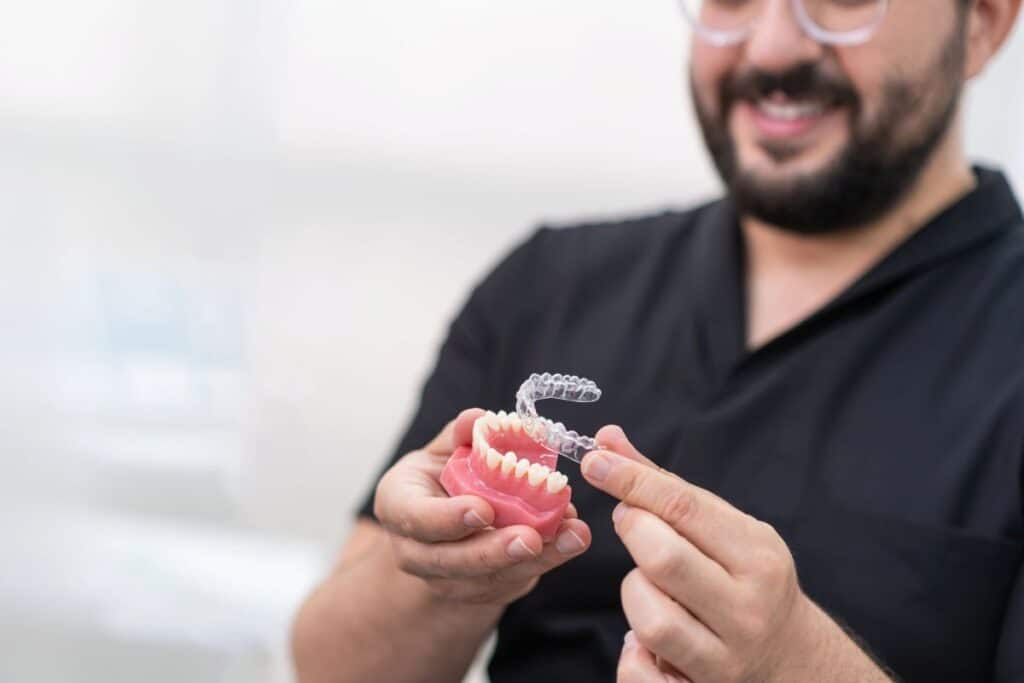
Clear aligners are built on planning, precision, and repeatable steps. That is the promise patients see in the marketing and the scans. In practice, teeth do not always follow the plan perfectly, even when wear time is solid and appointments are kept.
That is why refinements exist. They are a normal stage of aligner treatment, used to tighten the finish and improve long-term stability. If you want a baseline on outcomes, it helps to read how effective clear aligners can be for New Zealand patients, then come back to what happens when “nearly finished” needs fine-tuning.
Key takeaways
- Refinements are common and usually reflect normal biological variation, not “failure”.
- Tracking issues are easier to correct early than late.
- Wear time and attachment integrity have the biggest impact during the finishing phase.
- Bite settling drives many refinements, even when front teeth look straight.
- Reviews kept on schedule help reduce delays and retainer complications.
What refinements mean in clear aligner treatment
A refinement is an updated set of aligners created after progress is reviewed. The aim is to correct small differences between the planned movements and what has actually occurred in the mouth.
Refinements are not starting over. They are closer to recalibration. A new scan or impression is taken, the remaining movements are planned, and a new series of trays is produced to finish the alignment properly. A lot of refinement time can be avoided by making the right call upfront, so it helps to review the common mistakes people make when choosing teeth straightening.
This happens because aligner treatment blends engineering and biology. The planning is digital, but the response is human. Bone density, root shape, bite forces, gum health, and everyday habits all influence how teeth move.
Refinements are common, even when everything is done properly
Many people expect clear aligners to follow a straight line from first tray to last tray. That expectation is the issue. A digital plan is a prediction, not a guarantee.
Teeth can lag behind the plan by a fraction of a millimetre. That small difference can affect how later trays fit. Refinements are the tool used to bring reality back in line with the plan.
In clinical terms, refinements are quality control. They support a cleaner finish and help reduce relapse risk by improving the final bite and alignment.
Tracking determines whether the plan stays on schedule
“Tracking” describes how closely the teeth match the movement expected for a given tray. If tracking is good, the aligner seats fully and holds the tooth in the right position for the next step.
Tracking problems often show up as a slight gap between the aligner and a tooth edge. A tray can also feel uneven, or stay tight in one spot for longer than expected.
It is tempting to ignore a minor fit issue and keep changing trays. That approach can compound the problem. When trays stop tracking, the plan becomes less reliable and refinements become more likely.
Wear time becomes more important near the end
Wear time is the simplest lever in aligner success. It is also the one most likely to drift over time. Early changes are easy to see, which keeps motivation high. Later, progress becomes subtle and routines can slip.
The finishing stage often involves smaller movements. Those movements are less forgiving. A few days of reduced wear can prevent a tooth from fully expressing the intended change, which then affects the fit of later trays.
Consistent wear also matters for bite settling. If aligners are out for long stretches during meals, long coffees, social events, or shift work, the bite can remain unstable for longer and refinements can be needed to correct it.
Attachments and space management often decide the finish
Attachments are small tooth-coloured shapes bonded to certain teeth. They give aligners grip, improving control over rotation, root movement, and vertical changes.
If an attachment breaks or wears down, the aligner can lose control over that tooth. Wear time can be perfect and movement can still drift. Refinements then become necessary to regain precision.
Space management can also influence whether refinements are needed. Where teeth are crowded, tiny space limitations can prevent teeth from seating fully into their planned positions. When the final trays aim to refine contact points, that lack of space can show up as incomplete tracking or minor misalignment.
Bite settling is a common trigger for refinements
Patients often judge progress by looking at the front teeth. Clinically, the bite matters as much as the smile line. A straight-looking result can still have bite interferences that affect comfort and stability.
As teeth align, the bite can change. Some people notice that back teeth are not meeting evenly, or that one side touches before the other. Others feel a change in chewing comfort or jaw fatigue.
Refinements may be used to improve how teeth meet and function together. This can involve minor alignment changes to settle contacts and reduce interferences, which supports a more stable end result.
Timing and reviews in Auckland can affect refinement length
In a busy city, treatment can be influenced by practical scheduling pressures. Reviews matter because they catch tracking issues early, confirm attachment condition, and assess bite changes that are difficult to judge at home.
When reviews drift, issues are detected later and the correction needed is often larger. That can mean more refinement trays rather than fewer. It can also mean longer periods wearing passive trays while waiting for a new set to arrive.
The practical approach is straightforward. Keep reviews on schedule and report fit issues early. A tray that does not seat properly should not be treated as “normal tightness” for weeks. It is a sign worth checking.
Refinements help retainers fit better and improve long-term stability
Retainers are the part of orthodontic care that decides whether the result holds. The end of aligner treatment is not only about straight teeth. It is about stability.
If finishing is incomplete, a retainer can end up doing work the aligners did not complete. That is not what retainers are designed for. Retainers stabilise teeth. They are not meant to create significant active movement.
A well-managed refinement stage supports a more accurate final fit, which leads to a more predictable retainer phase. It also supports healthy adaptation of the gums and bone because the final positions are consistent and controlled.
This matters for adults in particular. Bite forces are stronger and tooth movement can be less forgiving. A refined finish reduces the chance of early shifting after treatment.
How to approach refinements without stress
Refinements are best viewed as finishing work. They exist to tighten precision, improve bite comfort, and support long-term stability. That framing is more accurate than treating refinements as a setback.
The practical fundamentals stay the same. Wear aligners consistently, follow tray-change instructions, keep review appointments, and report fit problems early. Avoid improvising fixes such as skipping ahead or cycling old trays without guidance.
It also helps to ask the right questions at the refinement stage. What movements are still being targeted. How many trays are expected. Whether attachments will change. How the bite will be checked before moving into retainers.
Where this leaves people starting clear aligners now
Clear aligner treatment is often smooth, but it is rarely a perfect straight line with no adjustments. Refinements exist because the system is designed to respond to real tooth movement rather than relying on prediction alone.
For many patients, refinements are the difference between a result that looks good and a result that holds up well. They can improve bite comfort, reduce relapse risk, and make the retainer phase more predictable.
In Auckland, the same principle applies as anywhere else. The plan works best when review timing is consistent, small issues are addressed early, and the finishing phase is treated as part of the process.